
Curated travel experiences

The Heartland Issue

The Eastern Cape, a journey into my 333 year family history in South Africa. 

Last month we took a family holiday to the Eastern Cape. We had planned it at the beginning of last year, and wanted it to include some time relaxing at the beach and some time exploring the Karoo heartland. It unexpectedly became a journey into family history for me.

During apartheid, an area of the Eastern Cape, called the Transkei, was created. Without going into the long, disgraceful and complicated history of apartheid, the Transkei was created as a “homeland” for black Xhosa-speaking South Africans. The Transkei was also where my mother and her 6 siblings (2 died at birth) were born and grew up. My mother was born in a tiny village almost nobody has heard of, called Cala. My grandfather recruited labour for the mines and my grandmother was a librarian. 

My grandmother comes from a very old Afrikaans family. We can trace our lineage back to Jean le Roux who sailed from France with his brother in 1688. My grandmother decided to do the unthinkable and marry a Scottish man, John Pringle. Today this doesn’t sound like a big deal, but to her Afrikaans family for whom the Anglo Boer war was within living memory, it was a disaster. John was also Catholic while my grandmother’s family came from a long line of austere protestants. I can just imagine the scandal this created in 1944. My mother was less controversial but also married a “foreigner”, my father being a British born Zimbabwean. Without intending to, I continued this pattern and married a Frenchman bringing our maternal lineage back to those intrepid French Huguenots! I remember my grandmother being proud to tell my husband about our family origins in France, although we have been South African for over 300 years.

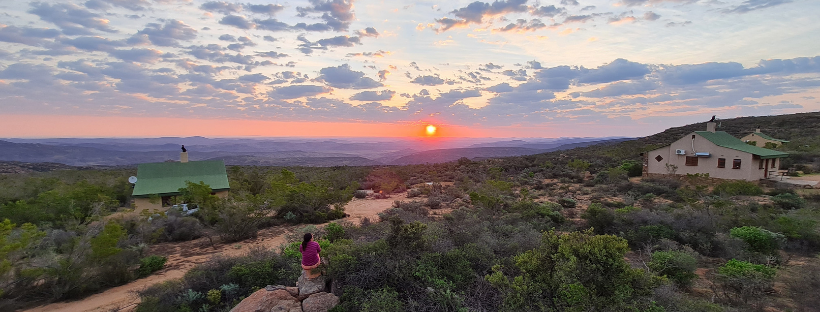
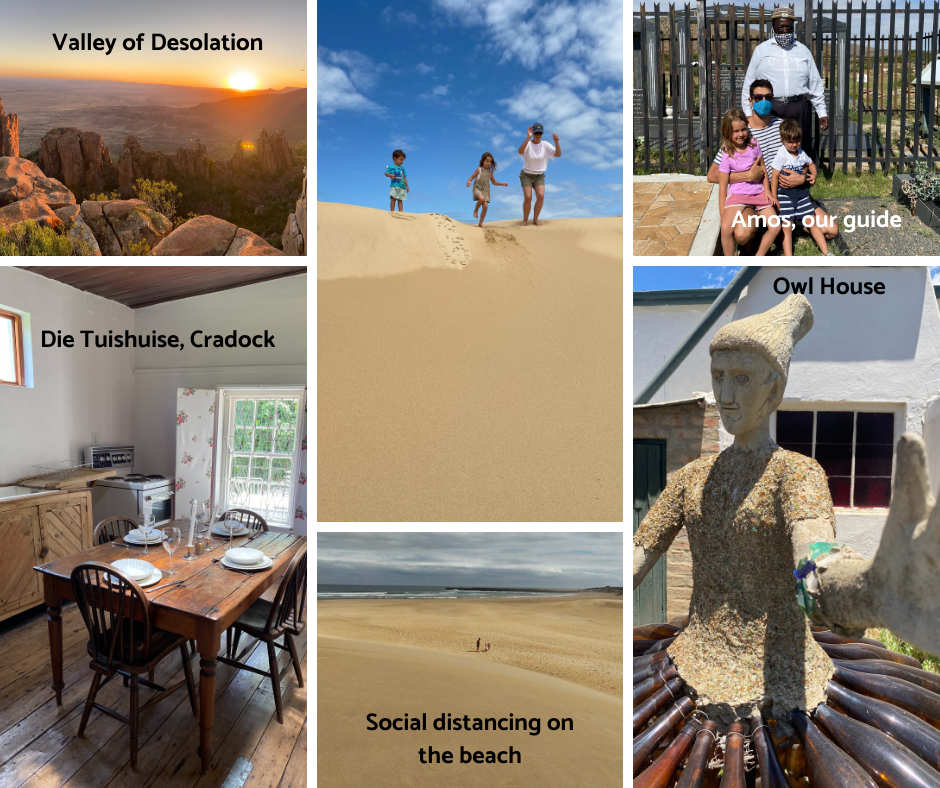
The Karoo is considered South Africa’s heartland. Its vast semi desert plains and mountains give it an outstanding natural beauty, but its warm and friendly people should be its true source of pride. On this holiday we stayed at Die Tuishuise in Cradock, and the staff here epitomise the remarkable hospitality of the region. I visited the Mountain Zebra National Park for the first time and we had some incredible sightings of birds and mammals in this small park. Mountain Zebra is only 15 minutes from Cradock and so it is wonderfully convenient to use Die Tuishuise as a base. We also did a tour to the graves of the Cradock Four, guided by the exceptional Amos from Die Tuishuis, pictured below. 

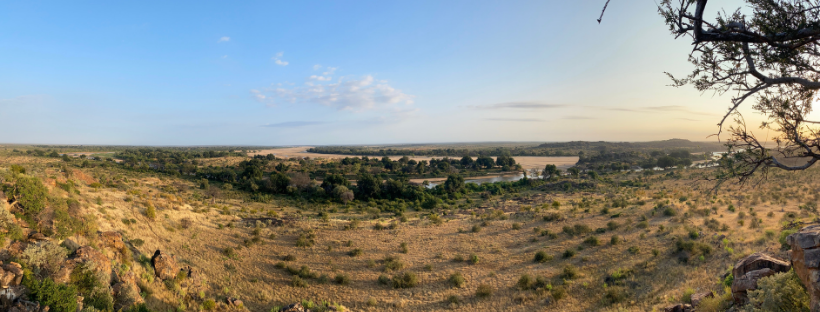
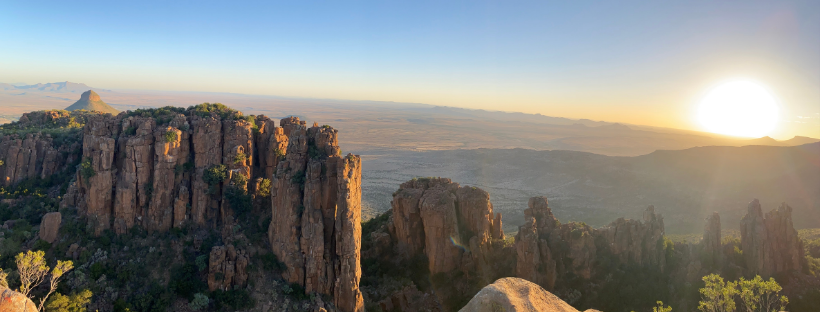
Another highlight of the trip was the Valley of Desolation in Graaf Reinet. It’s sheer cliffs and dolerite columns are truly breathtaking, especially at sunset. The view is pictured above and below. 

Lastly, the Owl House in the remote town of Nieu-bethesda is a strange and interesting place to visit. The roads are not tarred and we visited on a dry and windy day. The dust blowing through the quiet streets was eerie. We felt like we had been transported back in time to the start of the 20th century. My daughter was captivated by the fantastic Owl House sculptures that were created by Helen Martins and her assistants.

Recently, I have seen some small positive signs of people wanting to travel here again and nothing makes me happier!

Happy travelling,

Diana

Sign up for more newsletters like this here: https://mailchi.mp/2e4afa50d15f/leopard
Goodbye 2020

Let the old year end and the New Year begin with the warmest of aspirations. 

As this year comes to a close, and I reflect on the year that was, or more accurately, the year that wasn’t, I find that I have very little to say. In my newsletters through lockdown, I shared my thoughts on travel and these have not changed. People like us will still travel. While there are many reasons to be cautious right now, I find many more to be hopeful for what 2021 may bring. I am looking forward to welcoming my valued clients back to Southern Africa for many more memorable holidays. And I hope, in the first part of 2021, to launch tailor made holidays to France. 

A friend, some time ago, reminded me of how I loved to share my photos and experiences whenever I returned from a holiday to a new place. These were the days before ubiquitous social media, (circa 2005) and the way I shared photos was to show my colleagues a slideshow of my photos on my laptop. I am by no means an accomplished photographer, but I enjoyed doing this because I loved sharing things I learned about the country I visited, people I met, food I ate and sights I saw. I still feel that way. It is why I enjoy my job so much, because I get to do this every single day. It was interesting to be reminded of this habit of mine by my friend, who is now a successful business owner, and see the connection between that life and this.

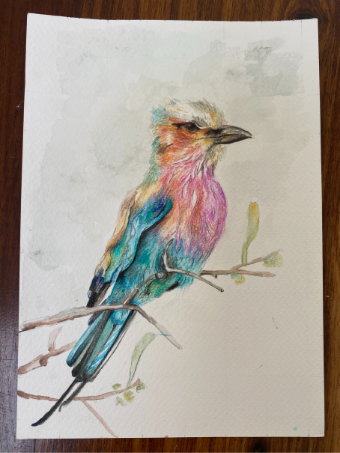
As a way to thank you for your continued support, I am giving away postcards! Without you, I couldn’t do what I love, which is to plan holidays for clients, and so this is my small way of saying thank you. The postcards will be made from an original painting done by my incredibly talented friend Jessica Maitland-Stuart. The painting is of a lilac-breasted roller, one of the most beautifully coloured birds in the bush. It is also known as Mzilikazi’s roller because its feathers were used to adorn the head-gear of the Matabele king. If you would like a handwritten postcard from me, featuring the beautiful original painting you see below, please reply to this email telling me where you want me to send it.

Let the old year end and the New Year begin with the warmest of aspirations. Happy New Year! 

Kind regards and best wishes,
Diana

Sign up for more newsletters like this here: https://mailchi.mp/2e4afa50d15f/leopard
The Welwitschia Issue

An ancient and truly remarkable plant.

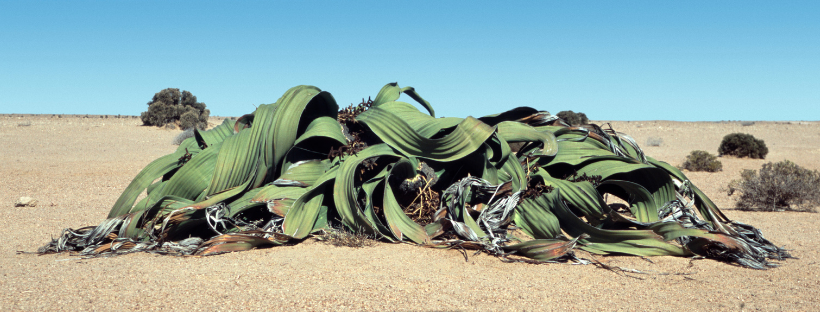
Welwitschia mirabilis is endemic to the Namib Desert, one of the world’s oldest and driest deserts. The plant has only two strap like leaves which grow throughout its lifetime. These leaves split and fray in the wind and heat, making it seem as though the plant has multiple leaves. The welwitschia has been around since the time dinosaurs roamed the earth, and carbon dating has estimated the average age of a welwitschia to be between 500 and 600 years, although some of the larger specimens are thought to be 2000 years old. 

Welwitschia is ecologically highly specialised, and is adapted to grow under arid conditions. Rainfall in the Namib is less than 10mm annually and in order to survive these extreme conditions the plant has adapted to receive water from the dense fog that forms when the cold north-flowing Benguela current meets the hot air coming off the Namib Desert. The plant’s large leaves collect water by condensation. In addition, it has a very long tap root to reach sources of water underground. The best way to see these “fossils” is from the town of Swakopmund. 

Namibia itself is a strange and remarkable place, not only because it is home to the welwitschia. It contains some of the most ethereal landscapes I have ever seen. Also, it has a coast called the Skeleton Coast which conjures up images of ghostly shipwrecks. Namibia is home to Etosha, one of the continent’s top national parks, known for its salt pans and rich fauna and flora. The hauntingly beautiful Namib desert, which gives the country its name, stretches from South Africa, along the west coast of Namibia to Angola. Read our highlights for a trip to Namibia here

If you read our newsletter on birdwatching, you will know that one my of parents’ clients was a bird fanatic who was keen to see the shoebill. I remember walking through the dune sea just inland from Walvis Bay with my father and this client, trying to find the Dune Lark, a small bird endemic to Nambia. We took a tape recorder (remember those!) and played its call to attract the bird. We heard it, but never saw it.

Happy travelling!
Diana

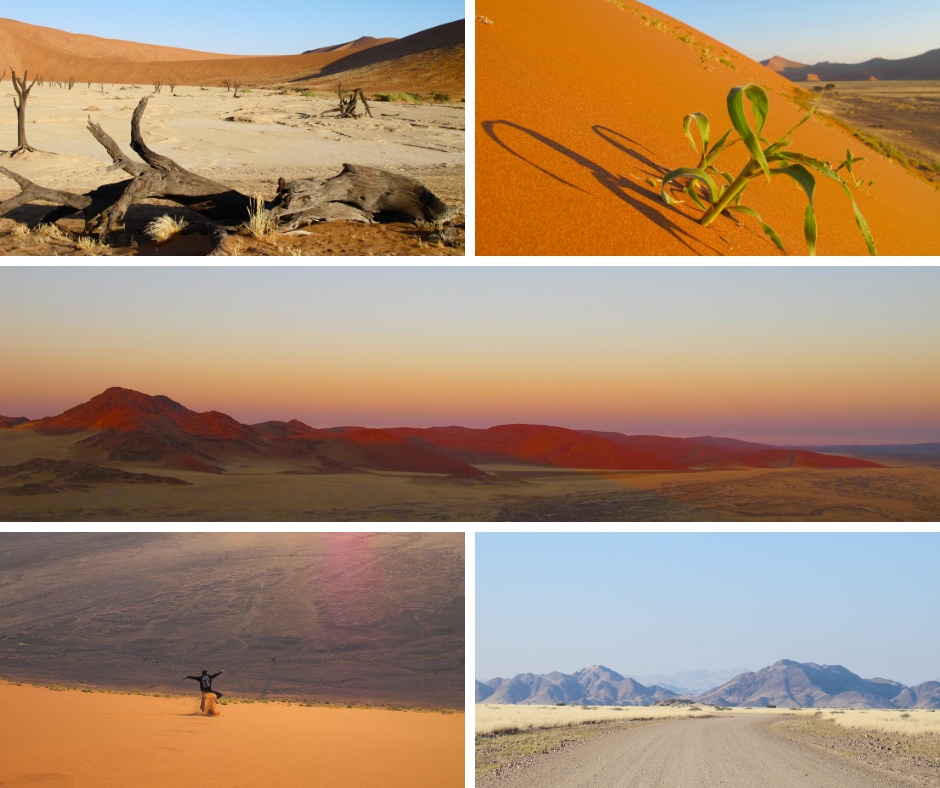
Below are some pictures from a 2012 trip to Namibia which included Sossusvlei, and a short video on the plant, if you are interested in knowing more. 

Sign up for more newsletters like this here: https://mailchi.mp/2e4afa50d15f/leopard
The Rhino Conservation Issue

How the white rhinoceros was saved from the brink of extinction. But their fight for survival is not over yet.

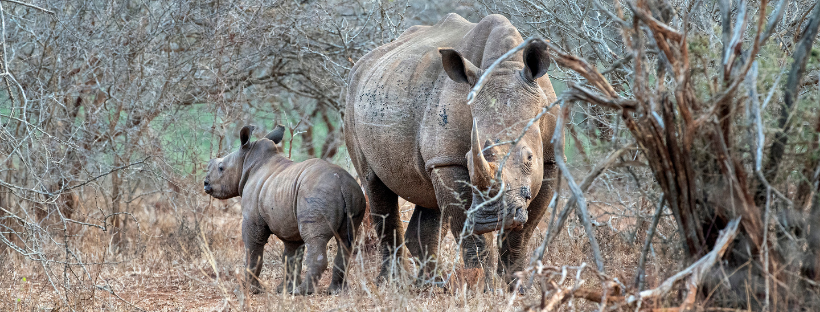
The famous hunter F.C. Selous said, in 1892, “Therefore the two white rhinoceros which I shot in 1882 are the last of their species that I have ever seen alive, or am ever likely to see…. I fully expected that these animals would become extinct.” Luckily for future generations, he was wrong. But rhino populations were severely depleted at the start of the twentieth century, having been slaughtered for their horn, hide and flesh. After being hunted to near extinction, rhino survival was further threatened by industrial agriculture which destroyed their natural habitat and finally, most insidiously, the promotion of so called traditional Chinese medicine by Mao Zedong

I recently read “The White Rhino Saga” by Dr Ian Player. It is a thrilling account of how the southern white rhino were saved, for the entire continent, in a little corner of South Africa. It was a team effort and Ian Player goes to great lengths to give credit to the many people who played their part, most notably the legendary Zulu game ranger and tracker, Magqubu Ntombela.

Ian Player arrived at an empty Umfolozi Game Reserve in 1952. In the preceding decade, the government had senselessly ordered that all wildlife in the buffer zones be shot in an effort to control the tsetse fly, which caused sleeping sickness. This did not work and the tsetse fly was only eliminated (along with many other beneficial insects) with the aerial spraying of the pesticide, DDT. It was in this context that Ian Player decided that every effort must be made to prevent the extinction of the rhinoceros. 

By 1960, the population of white rhino had been sufficiently restored so that the team could start thinking about relocating small groups to start new populations in other reserves, thereby decreasing risk of extinction if one population was destroyed. They started repopulating nearby reserves in northern Kwa Zulu Natal, then known as Zululand, but soon set their sights further afield. The last white rhino in Kruger National Park had been shot in 1896, and it was time for these great beasts to return. Mandhlagazi, Mfohloza, Mpila and Madhlozi were the vanguard of more than 800 white rhino who were eventually translocated by 1970. Today, on a week long visit to Kruger National Park, you are almost guaranteed to see white rhino. For this privilege, we should thank Dr Ian Player and his team. 

Capturing these gentle giants was no easy task and tranquillisers were at an experimental stage. Around the same time, rhino were being captured and moved as part of Operation Noah at Kariba Dam in Zimbabwe. My father’s great friend, Frank Junor, was a young scientist in the Operation Noah team, and I remember being captivated by Frank’s stories of how they rescued animals from drowning. Frank was a great raconteur and told one particular story with relish, about how he was gored in his left leg by a furious, injured buffalo who was lying in wait for him to return to his boat. Luckily the story ended well and Frank was rescued and made a full recovery. This video, from Operation Noah, clearly shows how difficult and dangerous it was to capture rhino in the early days.

To assist with the capture of the first rhinos at Umfolozi, a scientist, Dr Harthoorn, was brought out from Uganda in 1960. There was a lot of guesswork at this stage because nobody knew which drugs would work on rhino, neither did they know the correct weight of the animals. And so, it was with a lot of trial and error, and heartache at lost animals, that the team slowly became proficient at capturing rhino. Animals were lost along the way to overdoses, constipation, septic wounds, and from getting their horns stuck during transportation. In one particularly sad failed capture, a rhino reacted badly to the drugs and ran off a cliff. The team tried desperately to save him, but did not succeed. 

Today, the future is uncertain. The western black rhino was declared extinct in 2011 and there are only two female northern white rhinos left. They are kept under 24 hour guard. The greatest threat to the continued survival of rhino is the persistent poaching of the animals for their horn which is believed to have medicinal properties. This has been proven by science to be a complete fabrication but the belief still persists is fuelled by misinformation and human greed. 

Conservation and anti-poaching efforts are mostly funded by tourism with small contributions from governments. Since the temporary stoppage of tourism due to the global health pandemic, funds for conservation, especially for the salaries of the rangers who protect wildlife against poaching have dried up. If you would like to make a difference to conservation, and help fund ranger salaries, please consider donating to Ride4Rangers by clicking here


Happy travelling!
Diana


P.S. A number of private game reserves in South Africa offer once in a lifetime rhino conservation experiences where you are part of the team that does either a notching or dehorning. I highly recommend this one at Phinda in northern Kwa Zulu Natal, close to where Dr Ian Player was based. 

P.P.S A rhino conservation experience is not the same as activities such as lion cub petting and feeding elephants, which are not recommended. For further information, please read this short piece I wrote on animal interactions in South Africa.

Sign up for more newsletters like this here: https://mailchi.mp/2e4afa50d15f/leopard
The Birdwatching Issue

Of Shoebills, wetlands and walking safaris.

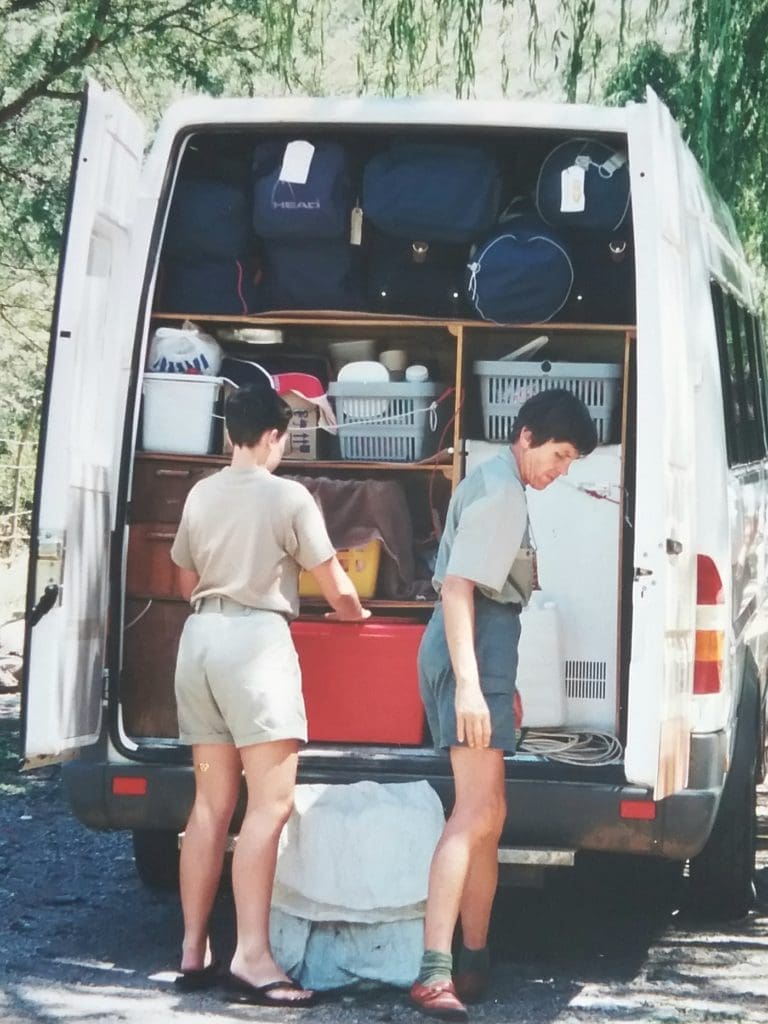
In 2000, I briefly joined my parents as an employee on their overland safaris in Southern Africa. My father had started his company in 1992 and with it, he wanted to take people into the wilderness areas of Africa. The company had evolved by 2000 into a specialist birdwatching and ecotour business. My father was in charge of the car, driving and guiding and my mother did the cooking, helped with guiding and did the reservations. I was responsible for washing the dishes and the car and organising breakfast at 5AM.

On these trips I was introduced to a new kind of birdwatcher, a “twitcher”. My parents had always enjoyed birdwatching and I could identify quite a few birds by the time I was 18. But I had never met a twitcher. A twitcher is a birdwatcher whose main aim is to collect sightings of rare birds. Every evening, the group sat around the campfire, with a beer or glass of wine in hand, and went through the bird list of the day. They ticked off the birds they had seen and if a member of the group had seen a “lifer” this meant that they had seen and positively identified a bird for the first time in their lives. There was much excitement and discussion during these soirées especially if the number of species spotted was large and many “lifers” were seen. Their clients were a passionate bunch. 

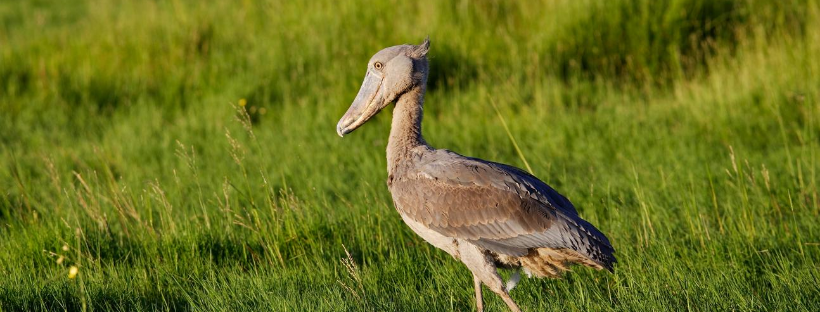
One of their clients told us about the bird he dreaming most of seeing. This bird was the Shoebill Stork. It is very rare, and rarely seen. It lives for 35 years, an extraordinary long time for a bird. It is also tall, up to 140cm. The signature feature of the species is its huge, bulbous bill which gives it an odd appearance. It is not a beautiful bird but its elusiveness makes it very attractive to birders.

The Shoebill captured my imagination and I also dreamed about seeing it one day, even though I am not a serious bird watcher. 20 years later and I have still not seen one, but I have a plan! The best place to see Shoebills is Zambia, specifically the Bangweulu Wetlands. Conservationists there monitor breeding sites and if you visit in May-July (to avoid long walks through watery wetlands) you should be able to see a Shoebill Stork in a stay of 3 days or longer. Incidentally, Zambia is one of the best places on the continent for walking safaris, especially North Luangwa where the shady trees and sparse vegetation make walking very pleasant compared to other places where the hot sun and dense bush makes walking uncomfortable. 


The reason there are so few Shoebills left in the world is because humans have systematically destroyed their wetland habitat. Conservation is precarious, especially with increasing pressure from humans. Tourism stopped during the global health pandemic and this meant that funds, in the form of conservation levies from tourists, dried up. Here at Leopard we believe that we need to make every effort to preserve diverse ecosystems for future generations. To do our part to help, we are supporting Ride4Rangers and invite you to do the same. We are hoping to raise ZAR 10 000 (USD 560) to support rangers who are the first line of defence to protect endangered species but in many places, there is no longer the funding for them. Please visit our JustGiving page here for more information on how to support this cause.

Happy travel dreaming!
Diana

Below, with my mom, on safari in 2000. 

Sign up for more newsletters like this here: https://mailchi.mp/2e4afa50d15f/leopard
The Escape Issue

Where can we go to feel like we are in another world?

I, like so many of you, have been confined to the place in which I live for the last few months. There is nothing that makes me dream of travel more than being told I cannot do so. To use this time productively and enjoyably, I have been seeking out new and exciting travel experiences and routes for Leopard clients. 

While South Africa’s beauty, diversity and excellent travel infrastructure makes it hard to beat in the region, I see that some people are searching for even more remote experiences. Places where they can truly escape their daily reality! Close to South Africa, there is Botswana with the incredible Okavango Delta, a truly unique wildlife destination. And, Mozambique’s islands are an excellent option for an idyllic beach island escape at the end of your holiday. 

Since I am already familiar with our neighbouring countries, I have been dreaming of places that are exotic and foreign to me. Places that are off the beaten track and that offer authentic and unique experiences for my clients. Top of my list of places to explore are Rwanda and the Congo Basin, which is also known as west equatorial Africa. 

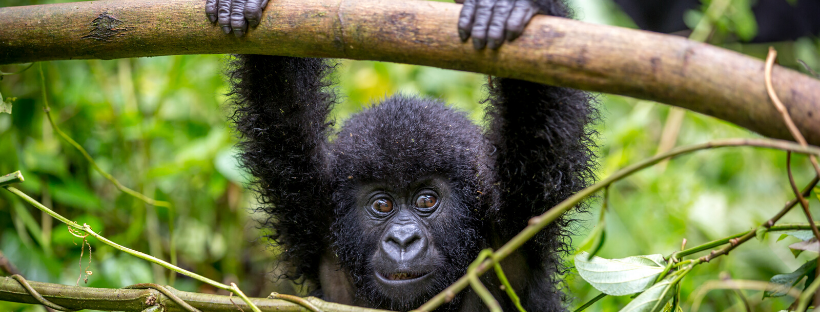
Seeing gorillas in the wild is one of those experiences that can change a person. With Covid-19, new protocols are being developed to ensure the safety of gorilla populations from viruses and diseases humans can pass on to them. Gorilla and human safety are so important and no risks can be taken. There are 3 places to see the highly endangered Mountain Gorillas: Rwanda, Uganda and the Congo. There are around 880 of these magnificent creatures left in the wild. You can see Mountain Gorillas in all 3 countries, but Rwanda has the most developed infrastructure. It is also a very easy, safe and culturally interesting place to visit. Gorilla permits are the most expensive in Rwanda, but it is one of the easiest places to see them if you don’t fancy a very long hike through thick bush. These factors make Rwanda is perfect if you’re looking for an easy and luxury experience. Rwanda is also very simple to add on to a South African holiday which could include a Big 5 safari in Kruger National Park and some time in Cape Town. The very good news is that Rwanda is open to tourists from 1 August. 

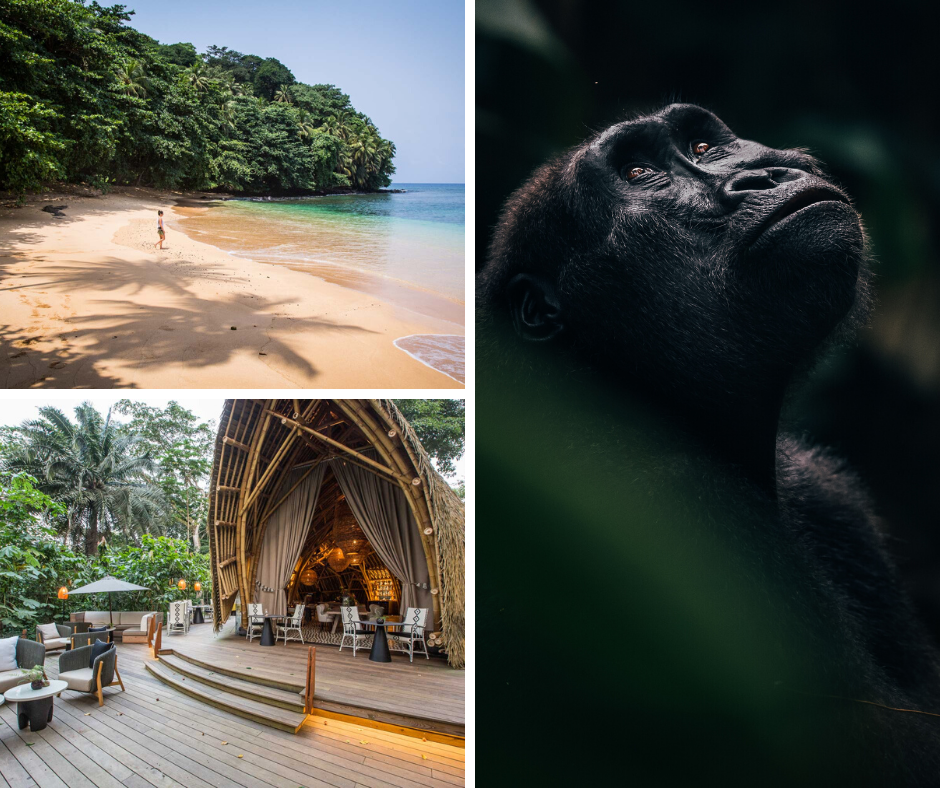
For something more remote, more adventurous, and definitely off the beaten track, I’ve been researching the Congo and Gabon and I really like what I see. It will not be for everyone, but a circuit between the Republic of Congo, Gabon and ending with a few days on the second smallest country in Africa, São Tomé and Príncipe island, looks amazing. Congo delivers something very different, authentic and life changing. Its remoteness makes it attractive but also challenging. You have to be prepared for less than convenient logistics. If you see this as part of the adventure, you will enjoy it. 

Another trend we see is that families want to connect with each other in a less stressful environment. South Africa has some excellent options for this with remote bush lodges that can be hired for exclusive use, meaning that you will not come into contact with people other than staff. 

Where are you dreaming of travelling to, when you can?

Happy travel dreaming!
Diana

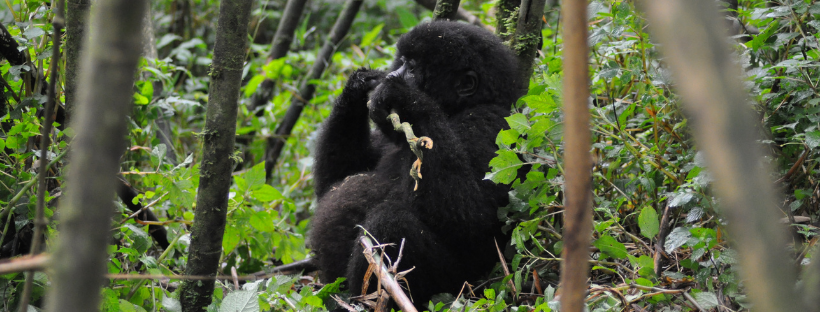
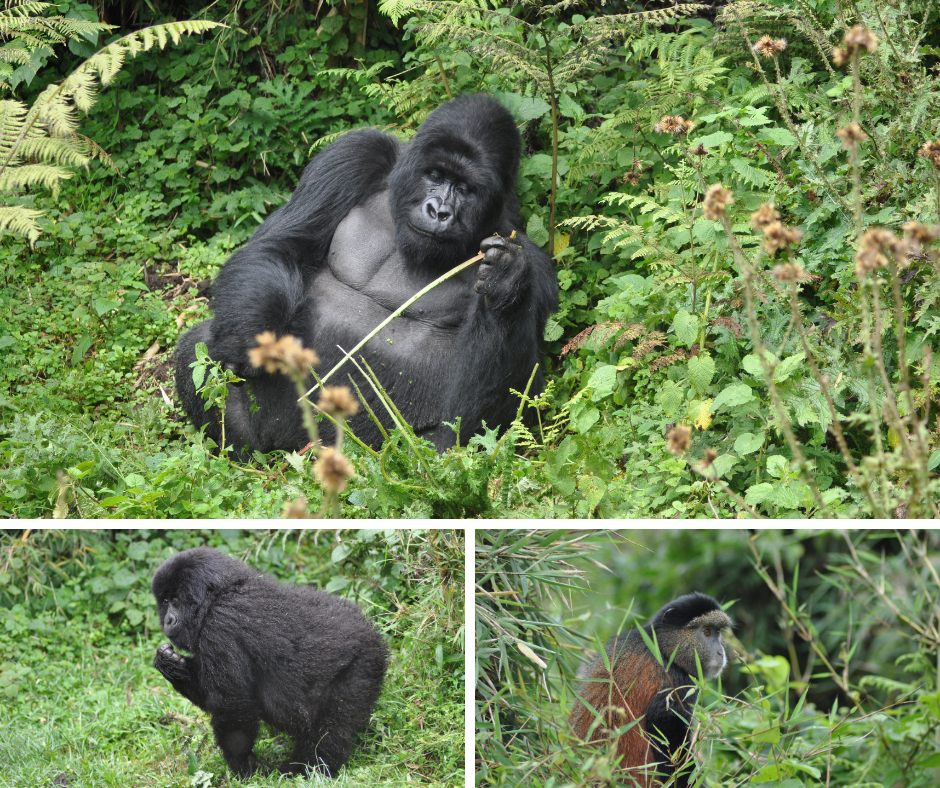
Above, a baby Mountain Gorilla plays in Rwanda. Below, a critically endangered Western Lowland Gorilla in the Congo. These gorillas, which are a different species from those visited from Rwanda, can be seen from Odzala Discovery Camp, which is part of the Congo Conservation Company.

Below you can also see Praia Sundy on Príncipe island. South Africa tech entrepreneur, Mark Shuttleworth, who incidentally was at the University of Cape Town 6 years before me and did the same degree, has funded a massive sustainable tourism venture on Príncipe, which Praia Sundy is part of. Photos of Praia Sundy are courtesy of Scott Ramsay/www.LoveWildAfrica.com.

Praia Sunday on Principe Island and a Western Lowland Gorilla in the Congo

Sign up for more newsletters like this here: https://mailchi.mp/2e4afa50d15f/leopard
The Family Issue

The ideal family holiday destination. 

When I think back to my childhood, my happiest memories are days spent together on family holidays. My favourite were our camping holidays in Zimbabwe and the Drakensberg. What about you? 

Now, as a parent myself, travel and holidays are something I take great pleasure in sharing with my children and husband. I try, as far as possible to expose my children to as many new environments, people and activities as possible, to open their minds. Because this is what travel is very good at.

“Travel is fatal to prejudice, bigotry, and narrow-mindedness, and many of our people need it sorely on these accounts.” Mark Twain

Apparently the rich learning environments created by travel can even make your children smarter. Of all the family holiday destinations you could choose, South Africa is one of the best. The diversity of experience in South Africa is unparalleled. From beaches to bushveld, mountains and deserts… and that is only the landscapes. There is also great diversity in people, culture, language and food. Being exposed to conservation of wilderness areas in one of our national parks, can lead to a lifelong interest in conservation for children; as can the exposure to our social issues and history give children empathy for those less fortunate. Whether learning experiences for your children are important or not, you will have endless amounts of family fun in South Africa. The variety of activities are endless, but I will leave that for another newsletter. 

I have worked on some incredible family holidays over the last 2 months and these holidays are close to my heart because I feel they have the potential to be life changing experiences for the families. Each family trip has been unique in its requirements and budget. For those with a higher budget, I have enjoyed selecting the very best South Africa has to offer. For those with lower budgets, such as a multigenerational family trip which included a self drive safari and basic national park accommodation, I worked hard to create the best value trip I could offer. For an adventurous family of 4, travelling to Africa for the first time, I helped curate a holiday that exactly suits their style of travel. For two families travelling together, with children ranging from age 7 to 21, it was important to select a safari lodge that will cater to their needs, as well as activities suitable for the whole family in Cape Town.

Regardless of budget, the experience of being together, in Africa, and particularly on safari will, without a doubt, be one of your most memorable family holidays. If you’re not convinced, just ask anyone who has been to South Africa. 

I collected some of my favourite photos of our family holidays in Southern Africa in the 1980s and 1990s into this album

I am standing by to help you plan the family holiday of your dreams, for late this year or 2021!

Happy travelling!
Diana

P.S. Our thoughts and best wishes are with all of those around the world affected directly or indirectly, personally or professionally, by COVID-19.

The impact to travel has been catastrophic, but we believe that we will emerge stronger than before.

Now, more than ever, we are all in this together. Please look after yourselves and look after each other.

Thank you all for your continued support, it means the world to us. 

Sign up for more newsletters like this here: https://mailchi.mp/2e4afa50d15f/leopard

The USA Issue

Chicago Travel and Adventure Show. 

I visited Chicago earlier this month for the Travel and Adventure Show. When I arrived, the city was covered in a blanket of snow and looked magical to my African eyes! It was so great to meet the lovely people of Chicago. We had wonderful conversations about Southern Africa with many seasoned travellers. I was encouraged at the enormous interest shown from the people of Chicago in visiting South Africa, Namibia, Botswana and Zimbabwe.

Pictures tell a thousand words, so take a look at a few photos from our time at the show below. We were so busy talking to clients that we didn’t get many photos, but enough to give you an idea! 

In case you missed the Newsflash last week, we interviewed people from all around the world about what makes a holiday special to them. And we had as many different answers as people we asked! Which is the very reason for Leopard’s existence… why take a packaged tour when you can get exactly what you want in a tailor made holiday from Leopard? Click here for #NobodyTravelsLikeYou

Happy travelling!
Diana

Sign up for more newsletters like this here: https://mailchi.mp/2e4afa50d15f/leopard
The Kwa Zulu Natal Issue

Undiscovered Kwa Zulu Natal.

I am so fortunate to travel across the length and breadth of my beautiful country on a regular basis. I find that each time I travel, there is something new to discover. 

In December, I returned to my home province of Kwa Zulu Natal for an extensive journey that took my family and I from the Anglo Boer battle fields at Spioenkop to the soaring Drakensberg mountains, laid back Durban, and then north, trailing through the immense iSimangaliso Wetland Park to Hluhluwe-Imfolozi and on to uMhuze and the Pongolapoort Dam which is tucked right up against eSwatini (formerly known as Swaziland). Our final stop was in tiny Wakkerstroom, in Mpumalanga. 

Kwa Zulu Natal is a lesser visited part of South Africa, but it truly has an impressive diversity of scenery, culture and experiences.

Another, rather surprising discovery this holiday, was that I like camping just as much as I like staying in luxury lodges and hotels. Thanks to high and exacting standards, 5 star hotels are universal in their beauty, cleanliness and overall sense of perfection. Whereas campsites are varied in their areas of dysfunction and discomfort. There is a universality present in beauty that is not there in ugliness and dysfunction. I am not suggesting that the campsites we stayed at were ugly. They were in some of the most beautiful and remote settings, such as Lotheni, in the Drakensberg Mountains, pictured above and below. In some places we struggled with electricity or water, badly designed bathrooms, lack of kitchen sink plugs and showers designed for midgets. But camping is so much fun and worth the effort. I love waking up to the sound of birds, and to feel so close to nature and the elements. You just feel more alive!

Leopard has had an incredible start to 2020, for which I am immensely grateful. I hope that 2020 is off to a good start for you too.

Wishing you many happy days of travel and discovery in 2020, and hope to welcome you to South Africa very soon!

Happy travelling!
Diana

P.S. The Leopard team will be in Chicago for the Travel and Adventure Show on the 8-9 February. If you would like FREE tickets, please email us!

P.P.S. To see more photos of the places we visited in KZN click here

P.P.P.S Did you see our video of Father Christmas’ African reindeers? Catch them here.

Sign up for more newsletters like this here: https://mailchi.mp/2e4afa50d15f/leopard
The December Issue

2019: A Year in Review.

First of all, thank you! To my small but bright community of newsletter readers, thank you for keeping in touch with Leopard each month through this newsletter. It means a lot that you choose to stay.

This year has been nothing short of incredible. I am so grateful that every day I get to wake up and do a job I love, even with all the problems, and the great challenge of coaxing a business to life from absolutely nothing. 

At the start of 2019, Leopard came into existence when my very first clients, John & Vicki, travelled to South Africa on 8 January. After these early pioneers, we had clients from France, USA, UK, Australia, New Zealand and South Africa. To create special, once off trips for each client, I visited 48 hotels and lodges across South Africa in 2019. This was hard work, but very enjoyable too!

Our vision remains to change the way people travel. With mass tourism negatively impacting some of the world’s greatest destinations, we want people to stop taking packaged tours, to go off the well beaten path and to truly experience the heart of beautiful South Africa. At Leopard, we create all our itineraries with this in mind, and only work with the best lodges, hotels and specialist guides to achieve this vision.  

Finally, I wish you all a good end to 2019 and a superlative 2020 filled with health, happiness and lots of travel!

Happy travelling!
Diana

P.S. We now accept credit card payments through Yoco. We are pleased to offer this service to you and hope it will make booking a holiday much easier. 

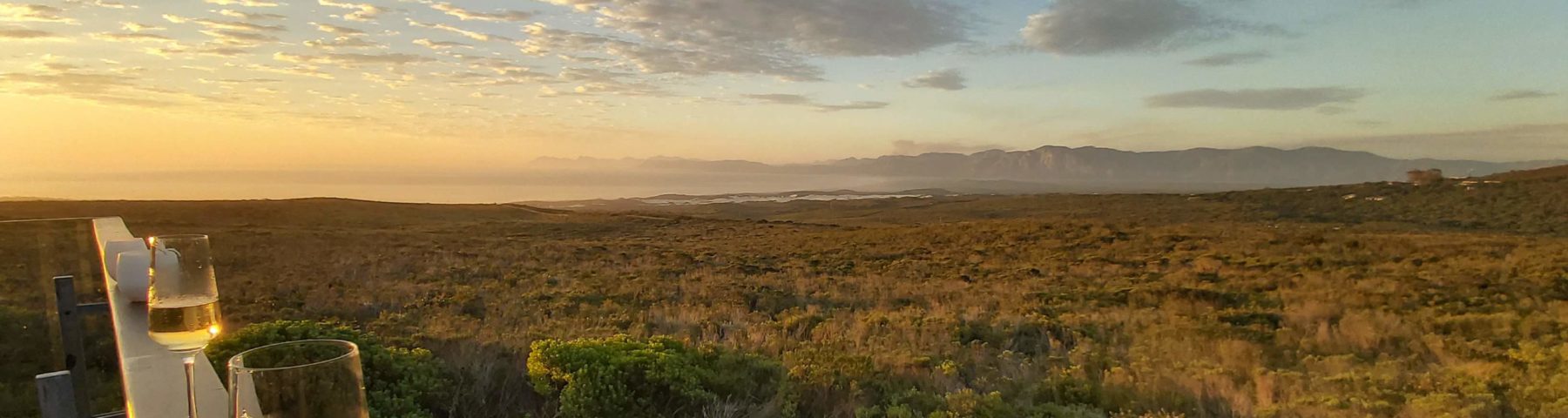
P.P.S. I visited Grootbos this month, to see photos of this fynbos paradise click here

Sign up for more newsletters like this here: https://mailchi.mp/2e4afa50d15f/leopard