At the last minute, I joined a trip to the Bale Mountains in Ethiopia in search of the endangered Ethiopian Wolf. Ethiopia has always fascinated me with its captivating history, beautiful wildlife, and vibrant indigenous tribes, and I was very excited to explore such an adventurous and diverse destination!
After an overnight stop in Addis Ababa, we headed straight to the Bale Mountain National Park with the single-minded mission to see and photograph the rare Ethiopian wolf. You may never have heard of or seen an Ethiopian wolf, as there are only an estimated 500 left in the wild. This critically endangered predator is a specialised hunter that feeds exclusively on rodents, especially giant mole rats. Their range is restricted to Ethiopia’s Afroalpine highlands, typically above 3,000 meters.
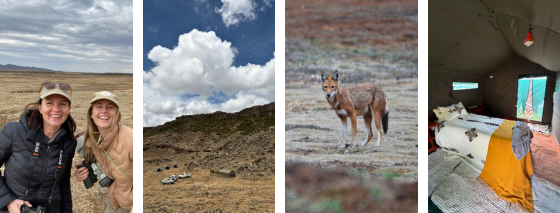
Their restricted habitat, specialised diet and the fact that they have the lowest genetic variability of any living canid, make them highly susceptible to extinction. Rabies, transmitted by domestic dogs, can wipe out entire packs, which is detrimental to their survival. Knowing all this made our first sighting of an Ethiopian wolf extremely exciting but also a little melancholic. I wondered whether my children would have the chance to see this beautiful animal during their lifetime.
Our first sighting was on an afternoon drive on our first day in the park. We saw a single wolf trotting briskly across the barren-looking landscape, searching for rodents which emerged from their burrows in a frenetic, whack-a-mole style. We had 7 different wolf sightings during the three-night trip, both from the car and on foot. Some were at a great distance and the others were at much closer range. Binoculars, although terribly difficult to bring into Ethiopia (you need to get approval ahead of your journey, or they may be confiscated by airport security), are a must, as well as a good lens for photography. One of the trip participants, Charlotte Arthun, is a well-known wildlife photographer. She recommends a minimum of a 400 to 600 mm lens and a teleconverter.
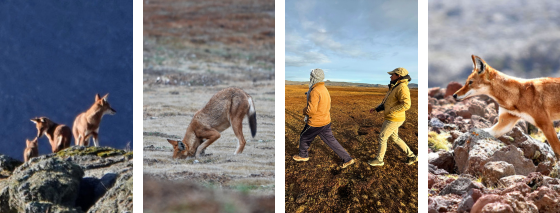
The most exciting moment of the trip came on our last morning when we spotted three adult wolves. We watched them for some time before they went to their nearby den and greeted two puppies. One of the adorable puppies was happy to be out in the sunshine and we watched as it frolicked and romped with the adults. This beautiful sighting also gave me a chance to admire the wolves’ stunning appearance: a bright rufous coat with white markings and a thick black-and-white bushy tail. What a rare privilege to witness the next generation of wolves at this den.
The “moorlands,” or ericaceous belt, of the Bale Mountains occurs at 3,400 – 3,800m. These alpine landscapes are sensationally beautiful and brought to mind another world, unlike anything I had experienced before. Besides spending time observing the wolves, I loved walking in these beautiful mountains. Everlasting flowers (Helichrysum citrispinum) with their waxy, papery petals and silvery-grey colour are abundant, and a variety of yellow-green sponge mosses punctuate the terracotta earth. As we walked, I noticed the vibrant colours of the orange and yellow lichens clinging to the grey basalt rocks and the earthy scent of the artemisia afra as my legs brushed against it.
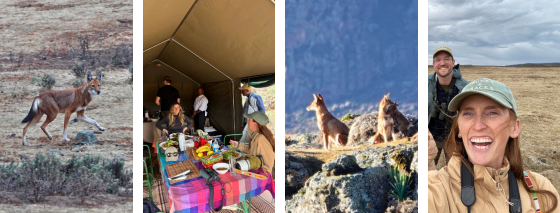
We also saw the extremely rare mountain nyala with one memorable sighting on foot. The bird watching here is superb, and besides some of the beautiful specials such as Rouget’s rail, blue-winged goose, ruddy shelduck, and black-headed siskin, we saw many raptors that came to feast on the abundant rodents here. Augur buzzards were present in large numbers and their high-pitched call regularly punctuated the silence of the mountains. I adore owls and we were lucky enough to see three Cape eagle owls on the trip.
There is very little infrastructure in the park so Wild Expeditions set up a fly camp in one of the most striking areas of the park: the Web Valley. This is also an excellent area to see the wolves. While conditions were harsh at this high altitude, with less oxygen and the cold, the camp was comfortable and extremely well run. Fires were hard to light with so little oxygen in the air, but the camp staff managed each night, and having a hot water bottle in our beds felt like the ultimate luxury.
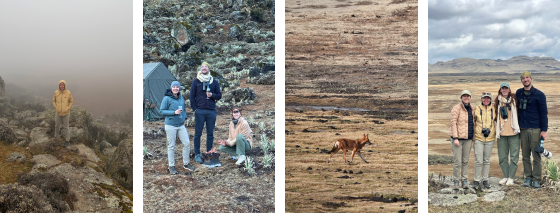
The food here was excellent and I don’t know how the chef managed to prepare such delicious food in a camp kitchen with no electricity or running water.
From the Bale Mountains, we returned to Addis before three of us continued on to the Omo Valley, which will be the subject of my subsequent newsletter.
If you’re ready to step off the beaten path and experience this extraordinary landscape for yourself, simply reply to this email for more information.
Happy travelling,
Diana
Sign up for more newsletters like this here: https://mailchi.mp/2e4afa50d15f/leopard
We are totally independent and not affiliated to any group of lodges, so you know that you’re getting the best itinerary and choice of accommodation on offer.
Crafting your ideal holiday can be a time consuming exercise, especially if you don’t know the region well, or you’re travelling in a group (like a multi-generation family holiday, or for a special celebration). We take your requirements and then distill and simplify all the travel info into a perfect itinerary for you. You’re welcome to be involved in the planning process as much, or as little, as you like.
Leopard is a small “human-sized” business offering personal touches. We want you to feel like you’re dealing with a real person who gives you the attention you deserve.
We specialise in curating itineraries that apply sustainable travel principles. One of our core company values is to support the conservation of biodiversity through travel. We recommend longer stays in each destination, supporting local small businesses and visiting off the beaten track attractions.
Our meticulous planning ensures our clients have a completely seamless experience, but in those instances where something goes wrong, we are available 24/7 to solve any problems.
We are true Africa experts. “My team and I visit almost every hotel and update our ‘little black books’ with hidden gems, so I can recommend the perfect stay for every client,” says Diana Granoux, Leopard’s founder and director.
We curate each journey for you. Every itinerary is handcrafted to ensure that it matches perfectly with your wishes. We tailor each itinerary so every detail feels perfect. From breathtaking beaches to adventurous safaris, spectacular views, hotels and knowledgeable guides.