Imagine standing on a grassy hill on the Wild Coast near Coffee Bay, watching hundreds of dolphins arch and leap through the ocean below. There’s no phone signal, so your phone is purely a camera to capture memories. Being present in the moment and unreachable to the outside world is liberating.
Or, picture yourself dipping your oar into tea-coloured, tannin-rich waters of the Touws River, along South Africa’s Garden Route, as a Knysna loerie flies from the branches of a tall Outeniqua yellowwood to a mirror image of its perch across the bank. You catch a glimpse of crimson in its wings. “Wow, did you see the loerie?” you call, looking over your shoulder to the rest of your family, split between two two-man kayaks behind you.
The Wild Coast and the Garden Route offer two different family holidays along South Africa’s southern and eastern coastlines. The Garden Route has more infrastructure and lots to do, while the Wild Coast appeals for the opposite reason: it’s remote and somewhat off the beaten track.
The Garden Route
A popular honeymoon and family holiday destination, the Garden Route is roughly a five-hour scenic drive or a short flight from Cape Town to George. It offers a variety of landscapes from indigenous forests to sandy beaches, sheltered lagoons and mountain scenery, with good restaurants and lots of activities for the whole family.
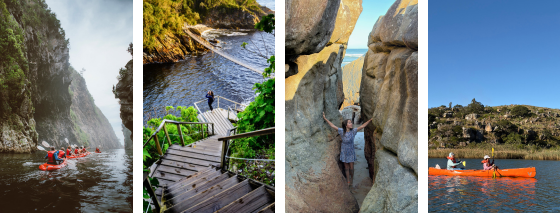
In Wilderness, you can paddle up the Touws River in a two-person kayak and then follow forest trails and boardwalks to a waterfall.
At Acrobranch Garden Route, the whole family can tackle elevated obstacle courses, rope bridges and ziplines among the trees, securely harnessed the entire time. Other zipline options include Mossel Bay’s long single-span zipline over the ocean and Knysna Ziplines, which criss-cross the Kranshoek gorge with spectacular views of the gorge and the sea.
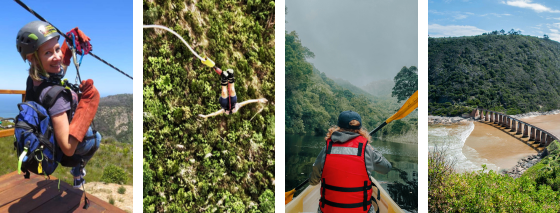
Bloukrans Bungy offers bungee jumping for the brave. For a gentler family adventure, we recommend the kayak and lilo tour at Storms River Mouth, or simply walk across the suspension bridge here and enjoy the views.
Knysna’s lagoon is ideal for a family boat trip. A cruise to the Knysna Heads is a lovely introduction to the area, while a trip up the Keurbooms River near Plettenberg Bay passes forested banks and green gorges. Look out for vervet monkeys, fish eagles and Knysna loeries (turacos). Some trips stop along the riverbank for a walk or picnic.
Plettenberg Bay is a good base for families who want to combine beach time with wildlife. You can swim with seals, or visit Birds of Eden near The Crags, where elevated boardwalks lead through a vast free-flight aviary set in indigenous forest. The two-hectare dome is home to more than 3,500 birds from over 220 species.
Next door, Monkeyland offers guided walks through forest inhabited by rescued primates, many of which have come from captivity. Its no-touch policy can teach children that responsible wildlife encounters involve no physical contact.
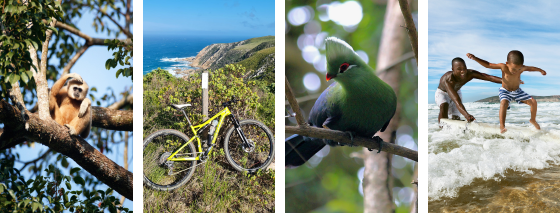
For beach time, Bollard Bay on Knysna’s Leisure Isle has sheltered, shallow water, while Wilderness and Plettenberg Bay are good for beach walks, sandcastles and bodyboarding. Central Beach in Plettenberg Bay is lively, while Keurboomstrand has a more natural setting backed by dunes and forest.
The Garden Route also has more refined dining than the Wild Coast. You can enjoy long lagoon-side lunches and polished dinners overlooking the water, enjoy gin tastings, or watch a game of polo. You’ll also find an excellent hiking and mountain-biking network, helicopter trips, the Big Tree and the wolf sanctuary. A holiday here allows room for discovery, adventure, an unplanned beach stop, or a second helping of ice cream.
The Wild Coast
The Wild Coast stretches from the Great Kei River, 90 kilometres north of East London, to the Mtamvuna River on the border of the Eastern Cape and KwaZulu-Natal. Rolling green hills dotted with traditional Xhosa homesteads descend towards rugged cliffs, river estuaries and long stretches of sand. The Wild Coast has fewer restaurants and organised activities than along the Garden Route, but for outdoorsy families, that’s part of the appeal.
To get there, fly to East London or Mthatha and then drive along the coast. Here, road conditions can vary wildly, and some accommodation is reached by gravel roads that may require a high-clearance vehicle or 4×4, so it’s sensible to factor in extra travel time.
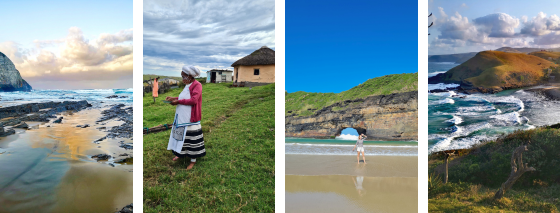
At Kei Mouth, you can cross the Great Kei River on the Pont, a vehicle-carrying floating ferry. Beyond the river, roads wind through rural villages to the ocean, where horse riding, fishing and coastal walks are relaxing ways to unwind.
Around Qolora and other rural communities, you can arrange a visit with a local guide to learn about Xhosa traditions and everyday life. These visits give children a chance to see how a community lives, and to ask questions that can’t necessarily be found online.
Further north, Coffee Bay has a sheltered bay that’s popular with surfers and sections of beach, where the river trickles into the sea, which are perfect for younger children to splash and play.
From Coffee Bay, hike (or drive) along the coast to the Hole in the Wall, one of the Wild Coast’s most striking landmarks. The sea has carved an arch through a rocky outcrop, and at high swell the waves surge through with a resonant boom. Known in isiXhosa as esiKhaleni, meaning “the place of sound”, it’s a visual reminder of how rugged this coast is.
At subtropical Port St Johns, you can also enjoy hiking, fishing and exploring the coastline. During the annual Sardine Run, usually in late June and early July, marine predators gather to feed on migrating shoals of sardines, attracting divers and snorkellers. Conditions are unpredictable, so these excursions are best for confident open-water swimmers.
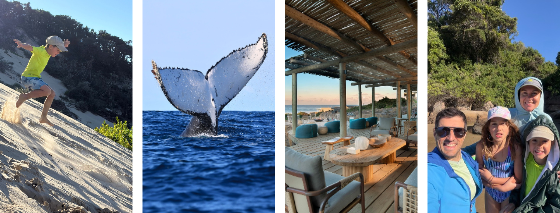
Further north in Pondoland, Pondo Beach Camps’ Msikaba camp offers a chance to get outdoors and discover your own entertainment. Diana and her family kayaked up the Msikaba River towards a Cape vulture colony above the sandstone gorge. Nearby Mkhambathi Nature Reserve has coastal walks through grasslands, past waterfalls and with dramatic sea views.
Diana’s eight-year-old son, Luc, caught his first wave on a bodyboard, while her daughter, Nina, climbed a dune across the river and bounced down it several times a day. On a windy afternoon, the family packed a picnic and walked along the coastline of Mkhambathi Nature Reserve towards GweGwe Lodge. The beach and river provided all the entertainment they needed. GweGwe is popular with clients looking for great quality accommodation during the sardine run, Earth’s largest migration. They tend to spend a week at GweGwe to fully enjoy the spectacle of wildlife chasing the sardines.
“Somewhere between the empty beaches, the long walks, and the lack of signal, I realised how rarely we let ourselves become unreachable. The Wild Coast reminded me that perhaps the greatest luxury isn’t access, but escaping it,” Diana shared.
Which should you choose?
If your children are restless, your teenagers need a challenge, or you want comfortable accommodation and good restaurants on tap, the Garden Route may be best. If your family needs to slow down, with fewer screens and lots of time in the open air, the Wild Coast could be a better fit.
If you’d like to know more about either region, we’d love to help.
Happy travelling,
The Leopard Team
Sign up for more newsletters like this here: https://mailchi.mp/2e4afa50d15f/leopard
We are totally independent and not affiliated to any group of lodges, so you know that you’re getting the best itinerary and choice of accommodation on offer.
Crafting your ideal holiday can be a time consuming exercise, especially if you don’t know the region well, or you’re travelling in a group (like a multi-generation family holiday, or for a special celebration). We take your requirements and then distill and simplify all the travel info into a perfect itinerary for you. You’re welcome to be involved in the planning process as much, or as little, as you like.
Leopard is a small “human-sized” business offering personal touches. We want you to feel like you’re dealing with a real person who gives you the attention you deserve.
We specialise in curating itineraries that apply sustainable travel principles. One of our core company values is to support the conservation of biodiversity through travel. We recommend longer stays in each destination, supporting local small businesses and visiting off the beaten track attractions.
Our meticulous planning ensures our clients have a completely seamless experience, but in those instances where something goes wrong, we are available 24/7 to solve any problems.
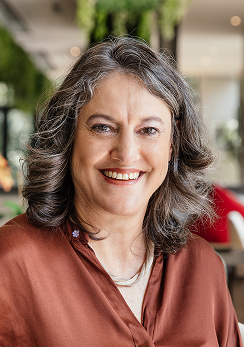
We are true Africa experts. “My team and I visit almost every hotel and update our ‘little black books’ with hidden gems, so I can recommend the perfect stay for every client,” says Diana Granoux, Leopard’s founder and director.
We curate each journey for you. Every itinerary is handcrafted to ensure that it matches perfectly with your wishes. We tailor each itinerary so every detail feels perfect. From breathtaking beaches to adventurous safaris, spectacular views, hotels and knowledgeable guides.